
US and Canadian spring Cropping
-Monday, April 14, 2002
This analysis featured in the April 14, 2002 issue of the HGCA's MI Prospect, Volume 4, Number 20
Key points
- North American spring wheat 20% of world trade, Spring coarse grains 50% of world trade
- Dryness in Canada
- Drought in US skirting spring area
- Wheat prices sensitive to drought developments this spring.
- Maize markets quiet except for summer weather markets.
Spring seeded cereals in North America represent eight percent of world wheat production, a third of world coarse grain production, and over 20 percent and about a half, respectively, of total world trade in these commodities.
North American spring crops in perspective.
Over 95 percent of Canadian wheat production is spring seeded. In contrast spring seeding of wheat in the US is limited in the main to the Dakotas and Montana which produce hard spring and durum wheat and contributes only about 25 percent of total US production. Almost all coarse grains and oilseeds in both Canada and the US are spring seeded.
Beyond the sheer size of output and trade in North American spring grain, the prospects for these crops are important as both area and yield can fluctuate significantly. Except in the drier areas where wheat dominates, farmers have cropping options and double digit percentage swings in the area seeded to specific crops are not uncommon. Over the last ten years US maize area has ranged between 25.5 and 29.4 million hectares, and Canadian wheat area has ranged between 10.4 and 14.2 million hectares.
With their shorter growing period spring seeded grains are also more susceptible to adverse growing conditions which because of the continental climate is more prevalent. Over the last ten years US maize yields have ranged from 6.3 to 8.7 tonnes per hectare while Canadian wheat yields have varied from 1.9 to 2.6 tonnes per hectare.
The five year range in North American production of 15.4 million tonnes for spring wheat and 96.3 million tonnes for coarse grains represent about 10 and 57 percent, respectively, of current global carry over stocks. North American spring grain output particularly for maize can thus very significantly effect the world market. Crop development is, therefore, watched very closely.
Current 2002 Crop Prospects
The first indicator of spring seeded crop prospects is the publication in late March of the USDA’s Prospective Planting survey of about 67,000 farmers in early March. This year the prospective maize acreage was estimated at 32.0 million hectares, four percent more than what they actually seeded in 2001 (see table). As importantly it was about 400,000 hectares more than the trade was expecting. The increased maize area came mainly from a reduced soybean area.
continue
US Prospective Planting
=======================
               Actual   Actual   Prospective Change
               2000     2001     2002        2002
               mln.hct. mln.hct. mln.hct.    percent
----------------------------------------------------
Corn              32.2     30.7     32.0         +4
Soybeans          30.1     30.0     29.5         -1
All Wheat         25.3     24.1     23.9         -1
Durum              1.6      1.2      1.1         -3
Spring Wheat       6.2      6.3      6.1         -3
Oats               1.8      1.8      2.1        +16
Barley             2.4      2.0      2.1         +2
Sunflowers         1.1      1.1      1.0         -7
Canola             0.6      0.6      0.6          0
----------------------------------------------------
Source: USDA March 28, 2002
continued
Allowing for forage maize acreage the Prospective Planting survey suggests a harvested area of about 29 million hectares, towards the top of the typical area for US maize.
While these intentions surveys are only an indication of farmers’ plans for spring cropping patterns about six weeks ahead of actual seeding, they do provide a fairly firm indication of crop area. Major changes in relative prices between crop option can influence farmers within crop rotation restraints as can wet seeding conditions. But these eventualities seem unlikely this year. Delayed field work in the US leads to a switch from maize to soybeans and in Canada from wheat to barley and canola
A similar Canadian Seeding Intentions survey report is not published until late April. But over the drier areas of the Canadian prairies where drought conditions persist, soil moisture in addition to market prospects will have a bearing on what is seeded. Elsewhere with next to no farm carryover farmers will be inclined to seed, a few standout niche markets aside, what does best for them with less than usual reference to market prospects and soil conditions.
Current thoughts are that in the drought areas farmers are likely to gamble on a break in the drought rather than an increase in summer fallow, but also to shift land to durum. Just south of the US border in Montana, which is facing similar drought conditions, the USDA Planting Perspective survey suggests that US farmers are going to do just this.
Outside the drought areas on the Canadian Prairies some increase in canola area from last year’s smaller than normal area is expected. The exceptionally high prices this season for heavy oats, distilling rye and yellow mustard are likely to attract large percentage increases in acreage but this will not be significant in terms of the major crops.
Significantly the drought conditions that are threatening the US winter wheat crop skirt the major Mississippi Valley spring cropping area (see chart). To the west the worst of the drought is centred on the High Plains but to the east of the Rocky Mountains drought conditions only stretch to the western edge of the Corn Belt. And to the east drought conditions on the eastern seaboard do not extend over the Appellation Mountains.
continue
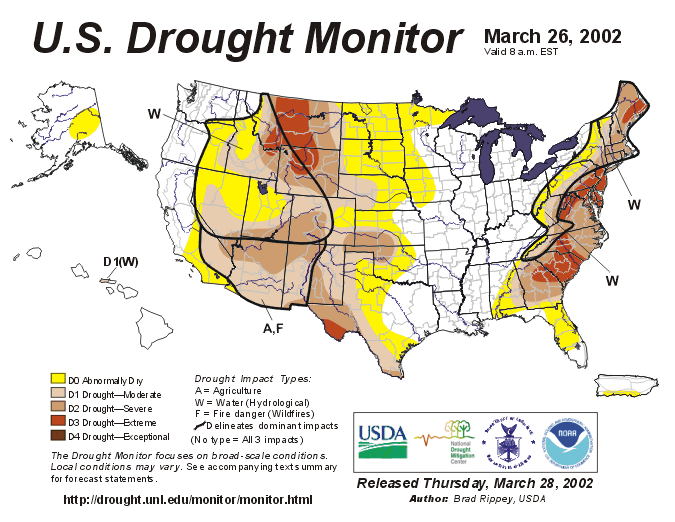
continued
The critical period for the development of the 2002 US spring crops will be in July for tasselling of maize and August for pod filing of soybeans. But at this time US spring crops, wheat excepted, are not threatened by weather conditions and an average crop is anticipated.
North of the border in Canada, even if rain fall is average this spring and summer, crops in the drought area, which has shifted slightly to the west and north but does not seem to have diminished, are expected to be below average. Current indications are that Canada will have nothing more than an average crop with some commentators suggesting it will have something less.
In aggregate North American spring wheat production could be below average which, combined with poor moisture over much of winter areas, suggests it will have much less than usual to export. For coarse grain and oilseed, however, another large crop is possible as Canada produces less than ten percent of total North American output and even a poor Canadian crop will have a very limited impact on total supplies.
Price Implications
For wheat there are real prospects for continuing drought condition materially reducing yield both for winter crops, which are beginning to come out of dormancy, and for spring crops where fieldwork will get under way in the coming weeks. Prices are likely to be very sensitive to weather conditions for several months.
For coarse grain in general, and maize in particular, a large crop is expected and prices reflect this. Exceptionally wet spring conditions would be required to produce any significant change is seeding plans. This suggests that price volatility based on planting progress may be limited. However, later in the summer weather-related price volatility may occur as yield potential develops.
However, for both wheat and coarse grains, without reliable long-term weather forecasts, it is too early to make any definitive forecasts of yields, supplies and hence prices.
David Walker
phone: 01603 705153
top of page